top of page

Points of Sail Explained
A sailboat can sail any direction except straight into the wind. The six points of sail, how lift pulls a boat forward, why upwind means zigzagging, and what beginners learn first.

If you’ve watched boats out on Lake Erie, the question that usually comes up first is how a
sailboat gets anywhere that isn’t straight downwind.
The answer is the points of sail, which are the angles a boat can hold relative to the wind. It’s
the most useful thing to understand about sailing. A sailboat can sail toward the wind, away
from it, and across it. The one thing it can’t do is sail directly into it.
Once that makes sense, everything a sailing coach says stops sounding like a foreign language.
How can a sailboat sail toward the wind?
A sail isn’t a bag that catches wind and gets pushed along. That’s the idea most people show up

with, and it only explains going downwind.A sail works more like an airplane wing turned on its side. Air moves across the curved surface
and generates lift, and that lift pulls the boat forward, including when the wind is coming from
ahead of you at an angle. The keel or centerboard underneath keeps the boat from sliding
sideways, so what’s left is forward motion.
That’s how a sailboat travels toward the wind. It can’t go straight at it, but it can get surprisingly
close.
What are the points of sail?
Picture the wind coming from twelve o’clock, with your boat in the middle of the clock face.
In irons is when you’re pointed straight at the wind, roughly eleven to one o’clock. The sails flap
and the boat stops. This is the dead zone, about 45 degrees either side of the wind, and every
beginner ends up here. It isn’t really a point of sail, it’s the absence of one. You get out of it by
backing the sail or paddling the bow around.
Close hauled is about one thirty or ten thirty, with the sails pulled in tight. This is as close to the
wind as the boat will go, and it’s the one that surprises people. The boat heels over, everything
feels urgent, and you’re sailing toward where the wind is coming from.
Close reach is around two o’clock, with the wind ahead of the beam but not as tight, and the
sails eased out a little. It’s fast and comfortable.Beam reach is three o’clock, with the wind straight across the side of the boat and the sails
about halfway out. This is usually the fastest point of sail and the easiest one to learn on, so
beginners spend a lot of time here.
Broad reach is four or five o’clock, with the wind coming over the back corner and the sails well
out. It’s relaxed and quick.
Running is six o’clock, with the wind directly behind you and the sails all the way out. It feels
slow even when it isn’t, because you’re moving with the wind instead of across it, so the breeze
on your face nearly disappears.
The same names apply on both sides of the boat. You’re on port tack when the wind hits the
port side first and starboard tack when it hits the starboard side. Which tack you’re on decides
who gives way when two boats meet, which is why sailors say it so often.
How do you sail somewhere upwind?

You zigzag.Since the boat can’t sail into the no-go zone, it sails close hauled on one side, turns through the wind, and sails close hauled on the other side, over and over. Each turn through the wind is a tack, and the whole zigzag is called beating to windward.
It takes longer than a straight line, and it’s the most tactical part of sailing, because every turn
costs a little speed and the wind keeps shifting. Deciding when to tack is most of what racing
sailors argue about.
Turning the other way, with the stern passing through the wind instead of the bow, is a jibe.
Jibes are faster and rougher because the sail crosses the boat with real force, so coaches teach
them carefully.
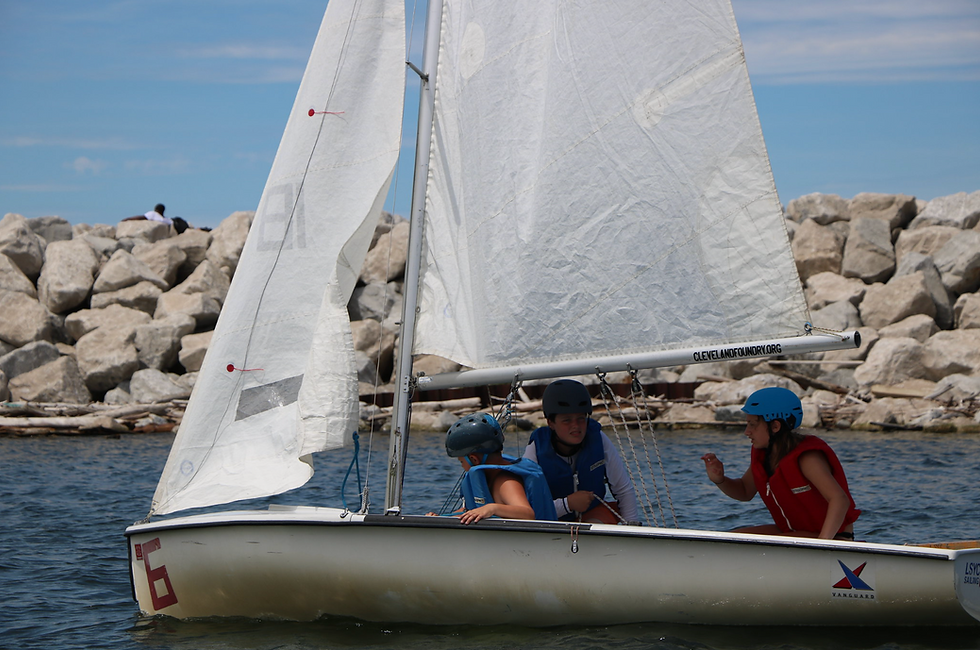
What does this look like at practice?
Beginners spend their first sessions on a beam reach, because it’s forgiving and it’s where a
boat feels most under control.
Close hauled comes next, usually with a coach explaining that the boat is supposed to heel and
that it isn’t going over. Running gets taught later than you’d expect, because sailing downwind is
trickier than it looks and a bad jibe is the quickest way to get a bump on the head.
The short version
If your kid needs to explain it at dinner: a boat can sail anywhere except straight into the wind.
To go upwind it zigzags. Sideways to the wind is fastest and directly downwind feels slowest
because you’re going with the wind. Turning the bow (front) through the wind is a tack and
turning the stern (back) through is a jibe.
That’s the whole framework, and everything else is detail.
The Cleveland Foundry teaches sailing on Lake Erie for ages five and up, from first-time sailors
through interscholastic and collegiate racing. You can see our programs at
clevelandfoundry.org/youth-sailing.
Keep reading

Rowing
What does “catching a crab” mean in rowing?
If you watch enough rowing, you’ll eventually see one rower stop dead, get folded backward over their own oar handle, and sometimes go over the side of the boat entirely. That’s catching a crab.
5 min →
Sailing
Points of Sail Explained
A sailboat can sail any direction except straight into the wind. The six points of sail, how lift pulls a boat forward, why upwind means zigzagging, and what beginners learn first.
5 min →
bottom of page